 After clearing the greens and leaving a 3 - 4" snow layer behind, moderate temperatures are able to melt the snow clear of the surface. Here #1 green was revealed within days of clearing it. By placing the turf covers in position the previous fall, the green surface will begin to warm slowly as the days heat up and the sun begins to shine. Also, by putting the covers into place prior to winter, in the event we need to remove ice throughout the winter or spring, the covers provide a protective layer to help in that process. The covers create a good separation from the green turf blades to aide in the ice removal process via shattering it and pushing it off.
STEWART CREEK GOLF & COUNTRY CLUB

Hole #1
Friday, April 8, 2011
GREENS
CLEARED GREENS  After clearing the greens and leaving a 3 - 4" snow layer behind, moderate temperatures are able to melt the snow clear of the surface. Here #1 green was revealed within days of clearing it. By placing the turf covers in position the previous fall, the green surface will begin to warm slowly as the days heat up and the sun begins to shine. Also, by putting the covers into place prior to winter, in the event we need to remove ice throughout the winter or spring, the covers provide a protective layer to help in that process. The covers create a good separation from the green turf blades to aide in the ice removal process via shattering it and pushing it off.


Monday, April 4, 2011
WEATHER


MORE SNOW
This past weekend we saw a storm bring 9-10" of fresh snow. On top of the vast amounts of snow we already have this newest snowfall dumped a large amount on greens we had already cleared. The 9" layer shown in the picture is on our practice green, so today we will clear the greens (with the tractor mounted snowblower) we had previously cleared to accelerate the melt. Greens that had fully cleared of ice and snow and are now soft and will see a natural melt as we won't put heavy equipment on them. If we were to not clear the greens this newest snow would be slow to melt and would only melt down to the snow and ice layer that was left behind the first clearing attempt. Just part of mountain golf life.
Thursday, March 31, 2011
WEATHER
 BLOWING SNOW OFF GREENS This week we began the process of clearing greens of snow. Temperatures have moved above +5C and night time temperatures are very moderate. This process involves using a snowblower to move the snow off the green surface. This particular year, with the vast amount of snow still present, requires more labor than in the past. Note in the photo breaking up the snow layers prior to the blower moving the snow. The snow depth shown here on #1 green varies from front to back, aproximately 30cm of snow on the green's front edge to 100-120cm along the back edge, evidence of snow drift throughout the winter. We blow the greens and leave a thin layer of snow behind to ensure a consistent melt and eliminate numerous freeze/thaw cycles which causes great stress to the turf. With the snow depths this season if we were not to help the snow along we would still have melting snow on the greens to the end of April.
Tuesday, February 1, 2011
WEATHER
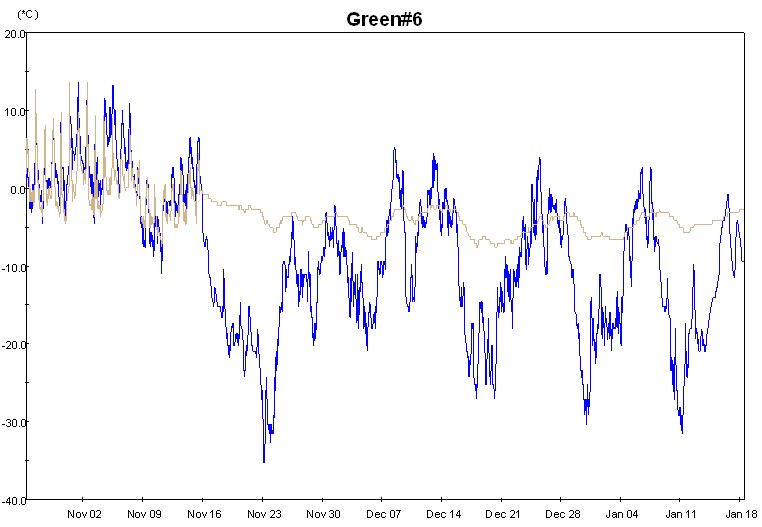
TEMPERATURE SENSORS FOR GREENS
To monitor the greens during the winter months we utilize data loggers and temperature sensors to track detailed temperature conditions. The photo on the left depicts the data collected which shows the "blue" actual air temperature and the "brown" under the snow/turf cover temperature of the green. Note on November 15th the "brown" under snow temperature stabilized as evidenced by the first winter snowfall.
Throughout the winter, to date, we have seen actual air temperature lows of -34C and highs of +11C however the temperature under the covers and snow accumulation layer remains between -2C and -8C. It is always interesting how little the first snowfall can be, in this case 4", to create a proper insulating condition that protects the greens. Naturally, our total snowfall, >24" in most locations, stabilizes the temperatures through drastic freeze/thaw cycles in the middle of winter and spring. By tracking temperatures we are able to monitor green conditions accurately to determine if ice is forming (too warm) or if the green is susceptible to cold temperature kill (too cold). Click on the photo to see a larger picture of the graph.
Monday, January 10, 2011
WILDLIFE
ELK ON THE GOLF COURSE IN WINTER
 It is very common to see elk moving and feeding on the golf course throughout the winter. Here we have several elk that have worked through the snow to the turf to feed. There was actually a herd of 80 elk spread out along #2 fairway(shown), #3 and #4 fairway, in trees and out in the open. They also will "bed" down in the open areas, that is they will clear snow away to lay down on the turf (as it is much warmer than the outside temperatures). These spots that the elk feed or lay down on reveal themselves in spring time as discolorations due to the exposure to cold temperatures. In addition the elk urine through the snow creates dead patches of turf that need to be repaired in the spring. Yet another reason why we use protective fencing around all the greens in the off-season.
 It is very common to see elk moving and feeding on the golf course throughout the winter. Here we have several elk that have worked through the snow to the turf to feed. There was actually a herd of 80 elk spread out along #2 fairway(shown), #3 and #4 fairway, in trees and out in the open. They also will "bed" down in the open areas, that is they will clear snow away to lay down on the turf (as it is much warmer than the outside temperatures). These spots that the elk feed or lay down on reveal themselves in spring time as discolorations due to the exposure to cold temperatures. In addition the elk urine through the snow creates dead patches of turf that need to be repaired in the spring. Yet another reason why we use protective fencing around all the greens in the off-season.
Tuesday, November 23, 2010
WEATHER

Cold Temperatures Are Here
After the great, above-average fall temperatures we received we knew the cold weather would arrive sometime. It is now here. The photo shows a temperature of -25C during mid-day, warmed up from a -32C morning. Average temps for this time of year in the Canadian Rockies are highs of -1C and lows of -10C. Most of the course is covered under 3-6" of snow but some greens have had snow blow off certain spots and are exposed. Under the snow cover the turf is -5C when the ambient temp was -25C. A good indicator of how good an insulator snow can be.
Tuesday, November 2, 2010
DRAINAGE
Drainage Improvements Continue
 In addition to full course aeration, the excellent fall weather has allowed us to continue with aggressive subsurface drainage repair and additions. Here we show two "vents" being added to the back of #15 green. (Vents are surface exposure of 4" drainage pipe connected to the subsurface network). With no disruption to the actual green we utilized a drainage camera to map the subsurface drainage grid. We located spots for two vents at the back of the green. On this particular green we also located and opened
 In addition to full course aeration, the excellent fall weather has allowed us to continue with aggressive subsurface drainage repair and additions. Here we show two "vents" being added to the back of #15 green. (Vents are surface exposure of 4" drainage pipe connected to the subsurface network). With no disruption to the actual green we utilized a drainage camera to map the subsurface drainage grid. We located spots for two vents at the back of the green. On this particular green we also located and opened
two exits that were completely buried under rock and soil. Together this work will allow for the window effect, that is, to allow for air and water to move through the piping network similar to opening a window in your home. If you open one window there is no air flow. If you open a second window this allows for the air to move freely through the home. In this case it allows air to move more feely in the rootzone of the green, keeping grass roots healthy with the addition of extra oxygen and ensuring water movement out of the green. This has been very successful with many of our greens as in 2010 we have added 22 vents to date around the greens. We have also repaired and exposed 15 different drainage exits.
Subscribe to:
Posts (Atom)